CNN's published research
(CNN) -- Most Americans, white and black, see racism as a lingering problem in the United States, and many say they know people who are racist, according to a new poll.
But few Americans of either race -- just one out of eight -- consider themselves racist.
And experts say racism has evolved from the days of Jim Crow to the point that people may not even recognize it in themselves. (Watch people in a Texas town where blacks are still afraid to stop )
A poll conducted last week by Opinion Research Corp. for CNN indicates that whites and blacks disagree on how serious a problem racial bias is in the United States.
Almost half of black respondents to the poll -- 49 percent -- said racism is a "very serious" problem, while 18 percent of whites shared that view. Forty-eight percent of whites and 35 percent of blacks chose the description "somewhat serious."
Asked if they know someone they consider racist, 43 percent of whites and 48 percent of blacks said yes.
But just 13 percent of whites and 12 percent of blacks consider themselves racially biased.
Professor Jack Dovidio of the University of Connecticut, who has researched racism for more than 30 years, estimates up to 80 percent of white Americans have racist feelings they may not even recognize.
"We've reached a point that racism is like a virus that has mutated into a new form that we don't recognize," Dovidio said.
He added that 21st-century racism is different from that of the past.
"Contemporary racism is not conscious, and it is not accompanied by dislike, so it gets expressed in indirect, subtle ways," he said.
That "stealth" discrimination reveals itself in many different situations.
A three-year undercover investigation by the National Fair Housing Alliance found that real estate agents steered whites away from integrated neighborhoods and steered blacks in to predominantly black neighborhoods.
Racism also can be a factor in getting a job.
Candidates named Emily O'Brien or Neil McCarthy were much more likely to get calls back from potential employers than applicants named Tamika Williams and Jamal Jackson, even though they had the same credentials, according to a study by the University of Chicago.
Racial bias may even determine whether you can flag a cab.
New York Times writer Calvin Sims wrote a recent article about all the cabdrivers that refused to stop for him.
"If a cab passes you by, obviously it is frustrating, it's degrading and it's just really confusing, because this is akin to being in the South and being refused service at a lunch counter, which is what happened in the 60s and 70s," he said.
Victimized
The Opinion Research poll shows that blacks and whites disagree on how each race feels about the other.
Asked how many whites dislike blacks, 40 percent of black respondents said "all" or "many." Twenty-six percent of whites chose one of those replies.
On the question of how many blacks dislike whites, 33 percent of blacks said "all" or "many," while 38 percent of whites agreed -- a wash because of the poll's 5 percent margin of error.
About half of black respondents said they had been a victim of discrimination because of their race. A little more than a quarter of whites said they had been victims of racial discrimination.
The poll was based on phone interviews conducted December 5 through Thursday with 1,207 Americans, including 328 blacks and 703 non-Hispanic whites.
Tuesday, December 12, 2006
Friday, December 08, 2006
Man Up! Nobody Is Coming To Save Us
Hartford, CT (BlackNews.com) - This highly acclaimed novel has caught the attention and support of Bill Cosby and Rev. Al Sharpton. Each agree that it is a must read book for the community!
Man Up! states that internalized racism is the number one reason why the Black community is filled with: absentee fathers, mothers who raise their sons to be mamma's boys, bad eating, drinking and sexual habits, negative" thug" imagery, Black professional organizations mismanagement of resources, opportunistic Black intellectuals, and nobody is supposed to talk about it publicly. And most Black churches stand idly by as the band plays on.
Mr. Perry was born to a teenage mother and raised in public housing. He received his masters in social work from the University of Pennsylvania and his undergraduate degree from the University of Rhode Island. He has worked for various politicians (US Senators, Mayors and presidential candidates) and as the director for a homeless shelter. Mr. Perry is the principal and founder of the Capital Preparatory Magnet School in Hartford, CT. A school that prepares low-income high school students for college.
Steve Perry is currently on a national book tour! Steve has spoken on at least 50 different radio stations and will be speaking at: Lander University in Greenwood, SC; University of Louisiana at Shreveport, LA; and St. Philip's College, San Antonio, TX.
Check out his website: www.manupbook.com for additional information, booking, or interviews.
Title: Man Up! Nobody Is Coming To Save Us
Author: Steve Perry
ISBN: 0-9708929-2-6
Man Up! states that internalized racism is the number one reason why the Black community is filled with: absentee fathers, mothers who raise their sons to be mamma's boys, bad eating, drinking and sexual habits, negative" thug" imagery, Black professional organizations mismanagement of resources, opportunistic Black intellectuals, and nobody is supposed to talk about it publicly. And most Black churches stand idly by as the band plays on.
Mr. Perry was born to a teenage mother and raised in public housing. He received his masters in social work from the University of Pennsylvania and his undergraduate degree from the University of Rhode Island. He has worked for various politicians (US Senators, Mayors and presidential candidates) and as the director for a homeless shelter. Mr. Perry is the principal and founder of the Capital Preparatory Magnet School in Hartford, CT. A school that prepares low-income high school students for college.
Steve Perry is currently on a national book tour! Steve has spoken on at least 50 different radio stations and will be speaking at: Lander University in Greenwood, SC; University of Louisiana at Shreveport, LA; and St. Philip's College, San Antonio, TX.
Check out his website: www.manupbook.com for additional information, booking, or interviews.
Title: Man Up! Nobody Is Coming To Save Us
Author: Steve Perry
ISBN: 0-9708929-2-6
Thursday, December 07, 2006
"The Trivialization Of Black Suffering" from FN
This is from a brillant man's blog... I am in no way taking credit. This is merely a snippet. I encourage you to read the rest. From field-negro.blogspot.com
"So anyway, this charlatan is on Bill O'Rielly's FAKE NEWS television program, discussing the Danny DeVito meltdown on "The View". Of course, they were upset at not at his alcoholic induced meltdown, and lack of decorum, but of his rant against their beloved President Bush. So after some discussion about the issue, Goldberg makes what I think is probably as outrageous a comment as the ones made even by Richards: He says, and I am paraphrasing here, that he, DeVito, being on the "View" was like being at a Klan rally-I guess he should know-because every one on the show was agreeing with him-DeVito- about the President,and it was all these like minded people gathered in one place. So what the f**k!!! Are you serious? Comparing an appearance on a television show to being at a Klan rally. Maybe Mr. Goldberg doesn't realize how serious the sh** is that he is saying. Klan rallies were where plans were made to lynch my people and burn out and scare hard working families from the South off of their property and their land. Klan rallies are where groups were organized-and still are- to terrorize my people and keep us oppressed and in fear for years. And Klan rallies were held in secret with many prominent towns people and citizens taking part in the conspiracy of hate. The last time I checked, "The View" actually had black people on it.-Yeah I know Star Jones is gone, but they have had a token on damn near every day since- So how dare Mr. Goldberg makes that comparison? And why isn't America talking about it except on maybe a few left wing blogs like News Hounds?"
"So anyway, this charlatan is on Bill O'Rielly's FAKE NEWS television program, discussing the Danny DeVito meltdown on "The View". Of course, they were upset at not at his alcoholic induced meltdown, and lack of decorum, but of his rant against their beloved President Bush. So after some discussion about the issue, Goldberg makes what I think is probably as outrageous a comment as the ones made even by Richards: He says, and I am paraphrasing here, that he, DeVito, being on the "View" was like being at a Klan rally-I guess he should know-because every one on the show was agreeing with him-DeVito- about the President,and it was all these like minded people gathered in one place. So what the f**k!!! Are you serious? Comparing an appearance on a television show to being at a Klan rally. Maybe Mr. Goldberg doesn't realize how serious the sh** is that he is saying. Klan rallies were where plans were made to lynch my people and burn out and scare hard working families from the South off of their property and their land. Klan rallies are where groups were organized-and still are- to terrorize my people and keep us oppressed and in fear for years. And Klan rallies were held in secret with many prominent towns people and citizens taking part in the conspiracy of hate. The last time I checked, "The View" actually had black people on it.-Yeah I know Star Jones is gone, but they have had a token on damn near every day since- So how dare Mr. Goldberg makes that comparison? And why isn't America talking about it except on maybe a few left wing blogs like News Hounds?"
Obama 08'
I came across this video and thought i would share. I'm looking forward to see him run... if he decides to. This is him at his best.
Tuesday, November 28, 2006
The Segregationist Returns!
Reacquaint yourself with the new Senate minority whip...
I ran across this great video this morning. Everyone is focusing on KKKramer, like Rev. Jesse Jackson said,"What about Trent Lott?".
I ran across this great video this morning. Everyone is focusing on KKKramer, like Rev. Jesse Jackson said,"What about Trent Lott?".
This is the article from the Post
According to Hotline, Trent Lott is set to become the Senate Minority Whip.
In 2002 Trent Lott was one of the earliest casualties of blogger vigilance, when his praise of the racist, segregationist presidential candidacy of Strom Thurmond was picked up and amplified by the blogs. The corporate media simply couldn't ignore it.
It's not as if it were an isolated gaffe. As Wikipedia points out:
As a Congressman, he voted against renewal of the Voting Rights Act and opposed the Martin Luther King Holiday. Lott also maintained an affiliation with the Council of Conservative Citizens, which is described as a hate group by the ADL, NAACP and SPLC.
Or, if you prefer, watch PTV's and one of my favorite bloggers, Terrance Heath of Republic of T's, Video to the right.
After enough people noticed Lott's remark and it became a political liability, then -- and only then -- did the president and republican leaders speak out against the Mississippi senator, forcing him to resign his position as Senate Majority Leader.
They replaced the bigot with a failure, Bill Frist, while Lott will now become second in command to the post he once resigned in shame and ignominy. Frist will return to making ill-advised video diagnoses in Tennessee.
Source
Monday, November 27, 2006
... makes me speechless
"If I could have convinced more slaves that they were slaves, I could have freed thousands more."
-Harriet Tubman
-Harriet Tubman
Birth Defect
In April, 2006 in a interview Condelezza Rice referred to the US coming into being with slavery as an initial birth defect. I know it is an old interview but I liked that and thought i would share. That doesn't mean the rest of the interview was any good. She says we have come a long way since slavery but I say the racist ideal has just been suppressed. The people that were spraying the water hose at Black kids in the street are still alive. There children are the ones making the decisions in this country.
Roots
This information I got from the Wikipedia is interesting. It shows how deep rooted the separated or races are. Its like a White mother saying to her daughter,"Don't dare have babies with that Black man, don't dilute our precious race." Racism is so deep rooted, most of the time it isn't even seen. Because of that it continues, not enough people are standing up. Also a problem is a significant part of the Black population is not goal oriented. I know I am saying things that you already know. But here in this blog I am all about loving yourself and your race. Embracing your heritage.
I went off on a rant there but here is the info from the wikipedia
"British North America imported only about 500,000 Africans out of the 11 million shipped across the Atlantic.[2] Nevertheless, the United States has been astonishingly successful at preserving two distinct genetic populations: one of mostly African ancestry, the other overwhelmingly European.[3] All other New World states (except Canada) that imported African slaves have unimodal Afro-European genetic admixture scatter diagrams. Indeed, two thirds of white Americans have no detectable African ancestry at all (other than the ancient African ancestry shared by all members of our species, of course). Only one-third of white Americans have detectable African DNA (averaging 2.3 percent) from ancestors who passed through the endogamous color line from black to white.[4] Furthermore, U.S. government's surveys continue to categorize on a strict color-line. The federal census has no provision for a "multiracial" or "biracial" self-identity and, until 2000, forbade checking off more than one box. The EEOC has strict regulations defining who is black or white and implicitly denies the existence of mixed people."
I went off on a rant there but here is the info from the wikipedia
"British North America imported only about 500,000 Africans out of the 11 million shipped across the Atlantic.[2] Nevertheless, the United States has been astonishingly successful at preserving two distinct genetic populations: one of mostly African ancestry, the other overwhelmingly European.[3] All other New World states (except Canada) that imported African slaves have unimodal Afro-European genetic admixture scatter diagrams. Indeed, two thirds of white Americans have no detectable African ancestry at all (other than the ancient African ancestry shared by all members of our species, of course). Only one-third of white Americans have detectable African DNA (averaging 2.3 percent) from ancestors who passed through the endogamous color line from black to white.[4] Furthermore, U.S. government's surveys continue to categorize on a strict color-line. The federal census has no provision for a "multiracial" or "biracial" self-identity and, until 2000, forbade checking off more than one box. The EEOC has strict regulations defining who is black or white and implicitly denies the existence of mixed people."
Great African American
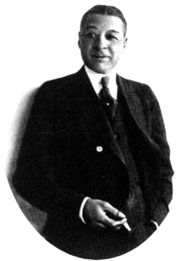 Bert Williams (November 12, 1874 – March 4, 1922) was the pre-eminent African American entertainer of his era.
Williams was born Egbert Austin Williams on the island of Antigua, then part of the British West Indies. In 1888 his family moved to Los Angeles, California. He began his entertainment career in 1892 in San Francisco.
Bert Williams was a key figure in the development of African American music. In an age when racial inequality and stereotyping were an 'accepted' part of life, he became the first black American to take a lead role on the Broadway stage, and did much to push back the racial barriers during his career. His songs (mostly self-written and displaying a dry wit and observational humor) such as "Nobody" and "All Going Out And Nothing Coming In" proved popular with audiences of all races, paving the way for future generations of black artists. Fellow vaudevillian W.C. Fields described Williams as "the funniest man I ever saw—and the saddest man I ever knew."
Saturday, November 25, 2006
Change.
"Tears will get you sympathy. Sweat will get you change."
-- Jesse Jackson, minister and activist
-- Jesse Jackson, minister and activist
Today in Black History
November 25
1895
National Negro Medical Association founded.
National Negro Medical Association founded.
1883
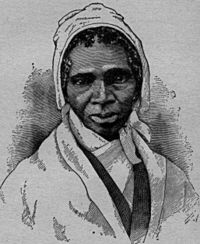
Sojourner Truth dies.
Background
Sojourner Truth (c. 1797–November 26, 1883) was the self-given name, from 1843, of an American abolitionist born into slavery from Hurley, New York. (Her original name was Isabella Baumfree, but some sources list her name as Isabella Van Wagener.)
Great African Americans
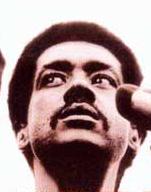
Bobby Seale (born October 22, 1936) is an American civil rights activist, who along with Huey P. Newton co-founded the Black Panther Party in 1966.
Seale joined the African American Association in college and this is said to have inspired him to start the Black Panthers, which at one point had over 2000 members. Seale went on to become the chairman of the party and underwent FBI surveillance as part of its COINTELPRO program. He was one of the original Chicago Eight defendants charged with conspiracy and inciting to riot, in the wake of the 1968 Democratic National Convention, in Chicago. Judge Julius Hoffman sentenced him to four years of imprisonment for contempt of court because of his outbursts, and eventually ordered Seale severed from the case, hence the "Chicago Seven." During one of the court trials Bobby Seale's many outbursts led the judge to have him bound and gagged, as commemorated in the song Chicago written by Graham Nash.
Seale was also tried in 1970 in the New Haven Black Panther trials for the murder of Alex Rackley and acquitted by a hung jury. The trials were widely decried as an example of political repression by such relative moderates as Yale University president Kingman Brewster, Jr., and were accompanied by a large demonstration in New Haven, Connecticut, on May Day, 1970, which coincided with the beginning of the US college student strike of May, 1970.
In 2002, he began dedicating his time to Reach!, a group that focuses on youth education programs.
Today Bobby Seale is popularly known for marketing a line of barbecue products.
Seale joined the African American Association in college and this is said to have inspired him to start the Black Panthers, which at one point had over 2000 members. Seale went on to become the chairman of the party and underwent FBI surveillance as part of its COINTELPRO program. He was one of the original Chicago Eight defendants charged with conspiracy and inciting to riot, in the wake of the 1968 Democratic National Convention, in Chicago. Judge Julius Hoffman sentenced him to four years of imprisonment for contempt of court because of his outbursts, and eventually ordered Seale severed from the case, hence the "Chicago Seven." During one of the court trials Bobby Seale's many outbursts led the judge to have him bound and gagged, as commemorated in the song Chicago written by Graham Nash.
Seale was also tried in 1970 in the New Haven Black Panther trials for the murder of Alex Rackley and acquitted by a hung jury. The trials were widely decried as an example of political repression by such relative moderates as Yale University president Kingman Brewster, Jr., and were accompanied by a large demonstration in New Haven, Connecticut, on May Day, 1970, which coincided with the beginning of the US college student strike of May, 1970.
In 2002, he began dedicating his time to Reach!, a group that focuses on youth education programs.
Today Bobby Seale is popularly known for marketing a line of barbecue products.
Moments in Black History
J. Edgar Hoover vs. Black Panter Party
Hoover's involvement with the Black Panther Party came as the party began to gain prominence during 1967 & 68. As COINTELPRO had been established in 1956 to police "political radicals" within the United States, focus and pressure now came onto the Black Panther Party. On June 15, 1969, J. Edgar Hoover declared, "the Black Panther Party, without question, represents the greatest threat to internal security of the country"; he pledged that 1969 would be the last year of the Party's existence.
As Roger states in the film (A Huey P. Newton Story), "if you read the FBI files you will see that even Mr. J. Edgar Hoover himself had to say that it was not the guns that were the greatest threat to the internal security of the United States of America; it was not the guns, it was the Free Children's Breakfast Program that was the greatest threat to the internal security of the United States of America. Grits. Now why was it the Free Children's Breakfast Program? It was the Free Children's Breakfast Program because the Free Children's Breakfast Program engendered a certain following on the Black community's part, a certain respect on the Black community's part. I mean, nobody can argue with free grits. So Hoover saw it as a kind of, he saw the Free Children's Breakfast Program as a kind of, what's the word he used? He said it was a kind of, look in the file, you'll see, he said it was a kind of infiltration. That's ridiculous isn't it? Infiltration? How are Black people, who are born and raised in the Black community, who live and work in the Black community, going to infiltrate their own Black community? If anybody's infiltrating I think its J. Edgar Hoover.
Source
Tuesday, November 21, 2006
KKKramer!
By now everyone should have seen the Michael Richards tirade from his stand up at a certain comedy club, well you should also know that he went on Letterman to apologizes. I want to state now I do not except his apology. Hes worthless and washed up and needs to sit his behind down somewhere in a dark hole where he might possibly be able to stop offending us "afro-americans", apparently we are our hair.
One of the worst sites on the internet
In my quest to scour the net for information to provide on my blog I came across a rather corny site
www.blackpeopleloveus.com/
Now normally I wouldn't want to link my page to something like this but I have to put it out there. This is one of the worst sites I have come across. It is not funny, in fact I am slightly offended (I say slightly because being completely offended would mean that I cared about this site). View it if you would like to see what is not appropriate.
www.blackpeopleloveus.com/
Now normally I wouldn't want to link my page to something like this but I have to put it out there. This is one of the worst sites I have come across. It is not funny, in fact I am slightly offended (I say slightly because being completely offended would mean that I cared about this site). View it if you would like to see what is not appropriate.
A Great People
"If you will protest courageously, and yet with dignity and Christian love, when the history books are written in future generations, the historians will have to pause and say, "There lived a great people—a black people—who injected new meaning and dignity into the veins of civilization." -- Martin Luther King Jr.
Today in Black History
November 21
1855
A Convention of California Blacks meet in Sacramento.
1865
Shaw University founded in Raleigh NC.
1893
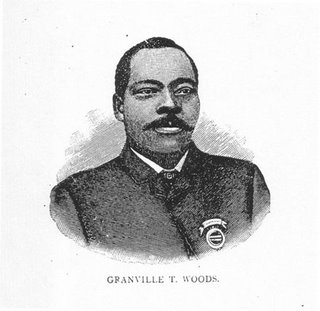
Granville T. Woods patents an electric railway conduit.
1904
Tenor saxophonist Coleman Hawkins is born in St. Joseph, MO, he will record "Body and Soul"
1944
Earl “The Pearl” Monroe, who will be noted for his electrifying basketball style, is born in Philadelphia, PA. He will be selected by the Baltimore Bullets in the first round of the 1967 NBA Draft and traded to the New York Knicks in 1971.
1962
Bowler George Branham, who will be the first Black to win the Professional Bowlers Association title, is born in Detroit.

1855
A Convention of California Blacks meet in Sacramento.
1865
Shaw University founded in Raleigh NC.
1893
Granville T. Woods patents an electric railway conduit.
1904
Tenor saxophonist Coleman Hawkins is born in St. Joseph, MO, he will record "Body and Soul"
1944
Earl “The Pearl” Monroe, who will be noted for his electrifying basketball style, is born in Philadelphia, PA. He will be selected by the Baltimore Bullets in the first round of the 1967 NBA Draft and traded to the New York Knicks in 1971.
1962
Bowler George Branham, who will be the first Black to win the Professional Bowlers Association title, is born in Detroit.
Monday, November 20, 2006
They are thinking about it?!?
I think they can kiss my back side. Why are they stmbling around it? If they want to appologize do it! It seems they are trying to create a media circus for the whole thing and there is no appology in sight.
British Government thinks about saying slavery was regretable
Press Association
Friday September 22, 2006
The Guardian
The government is considering issuing a statement of regret for the slave trade on the 200th anniversary of its abolition. Commemorations are to be held across the UK on March 25, two centuries after the passing of an 1807 parliamentary bill outlawing the trade in the British empire. The deputy prime minister, John Prescott, ruled out a formal apology for Britain's part in slavery earlier this year. But he will chair a meeting next month of the advisory committee overseeing preparations for the commemoration, at which proposals for a statement of regret are expected to be discussed.http://www.guardian.co.uk/humanrigh...1878270,00.html
British Government thinks about saying slavery was regretable
Press Association
Friday September 22, 2006
The Guardian
The government is considering issuing a statement of regret for the slave trade on the 200th anniversary of its abolition. Commemorations are to be held across the UK on March 25, two centuries after the passing of an 1807 parliamentary bill outlawing the trade in the British empire. The deputy prime minister, John Prescott, ruled out a formal apology for Britain's part in slavery earlier this year. But he will chair a meeting next month of the advisory committee overseeing preparations for the commemoration, at which proposals for a statement of regret are expected to be discussed.http://www.guardian.co.uk/humanrigh...1878270,00.html
Our Certain Unalienable Rights
"If we accept and acquiesce in the face of discrimination, we accept the responsibility ourselves and allow those responsible to salve their conscience by believing that they have our acceptance and concurrence. We should, therefore, protest openly everything . . . that smacks of discrimination or slander." -- Mary McLeod Bethune (1875-1955) "Certain Unalienable Rights", What the Negro Wants, edited by Rayford W. Logan (1944)
Today In Black History
November 20
1923
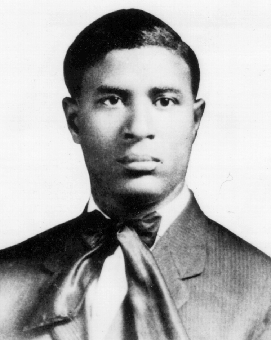
Garrett Morgan invented and patented the traffic signal,
Garrett Augustus Morgan (March 4, 1877, Paris, Kentucky - August 27, 1963, Cleveland, Ohio) was an African American inventor who originated a respiratory protective hood (although many people said it is a myth), invented a hair-straightening preparation and patented a type of traffic signal. He is renowned for a heroic rescue in which he used his hood to save workers trapped in a tunnel system filled with fumes.
1865
Howard University founded in Washington DC
Thursday, November 16, 2006
John Hope Franklin
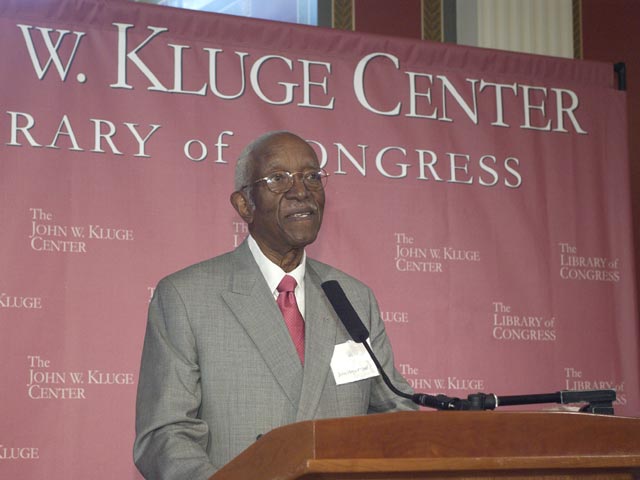 Duke University historian John Hope Franklin has won the 2006 John W. Kluge Prize for the Study of Humanity, a lifetime achievement award worth $1 million.The award, announced today by the Library of Congress, also was given to Yu Ying-shih, retired professor of Asian studies and history at Princeton University.Franklin, 91, was recognized for his pioneering work that examined how African-Americans shaped the nation. Librarian of Congress James H. Billington, in a statement about Franklin, said: "The transformation he has helped bring about in how we think about American history and society will stand as his lasting intellectual legacy."Franklin's landmark survey of black history, "From Slavery to Freedom," was published in 1947 and has introduced hundreds of thousands of students to the African-American experience.In 1997, Franklin was appointed by President Clinton to lead a national discussion on race.http://www.newsobserver.com/102/story/510691.html


The Souls of Black Folk
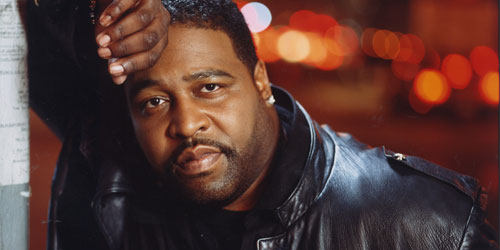
"It is a peculiar sensation, this double-consciousness, this sense of always looking at one's self through the eyes of others. . . . One ever feels his twoness,—an American, a Negro; two souls, two thoughts, two unreconciled strivings; two warrings ideals in one dark body, whose dogged strength alone keeps it from being torn asunder." --W.E.B. Du Bois (1868-1963) The Souls of Black Folk (1903)
Today in Black History
November 16
1873
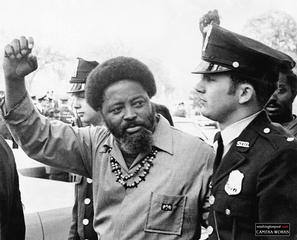
W.C. Handy, Father of the Blues, is born in Florence, AL. He will compose numerous hits such as "St. Louis Blues" and "Memphis Blues".
1941
Composer and organist Edward Margetson is honored by the Schubert Music Society at the American Academy of Arts and Letters.
1981
Pam Johnson is named publisher of the Ithaca Journal (NY), becoming the first Black woman to run a daily newspaper
2000
Coca Cola settles race discrimination case to approximately 2,000 African American workers for $193 million in compensation. This is the biggest settlement in the history of USA Coca Cola.
2000
Civil Rights activist Hosea Williams dies from prostate cancer at the Piedmont Hospital in Atlanta, GA. He was a top lieutenant to Dr. Martin Luther King, Jr. who continued the battle for civil rights long after King's death.
1873
W.C. Handy, Father of the Blues, is born in Florence, AL. He will compose numerous hits such as "St. Louis Blues" and "Memphis Blues".
1941
Composer and organist Edward Margetson is honored by the Schubert Music Society at the American Academy of Arts and Letters.
1981
Pam Johnson is named publisher of the Ithaca Journal (NY), becoming the first Black woman to run a daily newspaper
2000
Coca Cola settles race discrimination case to approximately 2,000 African American workers for $193 million in compensation. This is the biggest settlement in the history of USA Coca Cola.
2000
Civil Rights activist Hosea Williams dies from prostate cancer at the Piedmont Hospital in Atlanta, GA. He was a top lieutenant to Dr. Martin Luther King, Jr. who continued the battle for civil rights long after King's death.
Police Brutality Video found On YouTube
A witness shot a video of police beating a suspect. He took the video to the local police department and no one there did anything about it... so the witness put it on you tube.
The Link to the video.
The Link to the video.
Tuesday, November 14, 2006
Today in Black History
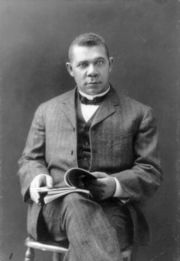
November 14
Booker T. Washington died, 1856 - 1915
Background
Booker Taliaferro Washington (April 5, 1856 – November 14, 1915) was an American political leader, educator and author. He was one of the dominant figures in African American history in the United States from 1890 to 1915.
Washington was born into slavery to a white, slave owner father and a black, slave mother in Franklin County, Virginia. He learned to read and write while working at manual labor jobs. At the age of sixteen, he went to Hampton, Virginia to Hampton Normal and Agricultural Institute, now Hampton University, to train as a teacher. In 1881, he was named as the first leader of the Tuskegee Institute in Alabama. He was granted an honorary Masters of Arts degree from Harvard University in 1896 and an honorary Doctorate degree from Dartmouth College in 1901. Washington played a very prominent role in black politics.
Washington was born into slavery to a white, slave owner father and a black, slave mother in Franklin County, Virginia. He learned to read and write while working at manual labor jobs. At the age of sixteen, he went to Hampton, Virginia to Hampton Normal and Agricultural Institute, now Hampton University, to train as a teacher. In 1881, he was named as the first leader of the Tuskegee Institute in Alabama. He was granted an honorary Masters of Arts degree from Harvard University in 1896 and an honorary Doctorate degree from Dartmouth College in 1901. Washington played a very prominent role in black politics.
Blatantly Racist
This is a story out of Baltimore MD. where a frat themed their Halloween party "Halloween In the Hood", you can read on but continuing on they called Baltimore an "HIV pit" and encouraged people to come dressed in "bling bling..." They even had the nerve to put a dark-skinned pirate hanging out front of the house in a noose.
The article:
BALTIMORE, Md. -- A John's Hopkins University fraternity has been barred from holding any more functions on campus after a controversial Halloween party was held this weekend.
JHU suspended all activities at the Sigma Chi fraternity during an investigation into the house's conduct last Saturday.
Angry students labeled that fraternity racist as they protested for hours along Charles Street in Baltimore Monday.
The protests were in reaction to an e-mail invitation to the fraternity house Saturday night. It referenced the party's theme: Halloween in the hood.
The e-mail called Baltimore an "HIV pit" and encouraged people to come dressed in "bling bling, ice ice."
The fraternity also had a dark-haired, stuffed pirate hanging from a noose out front of the house.
"I was appalled," said Christina Chapman, president of the Black Student Union.
"It's just very racist. There's no way you can be productive on this campus and come together as students and do things like this that they know are offensive and that they know are historically hurtful, considering black people were historically lynched in this country," Chapman said.
While the students protested, the university launched an investigation.
The fraternity declined to comment to WBAL TV 11 News.
"This should not be happening in a university community. There ought not to be an appeal to racial stereotypes as part of a party or advertisement for a party. It just shouldn't happen," said Dennis O'Shea, a spokesman for the university.
"Two of the students also went inside. There were students who said they were dressed in hood attire and slave attire. There was someone in a wife beater and overalls and barefoot with a straw hat impersonating a slave," Chapman said.
"The fact that this happened is a real shame. I hope that it won't overshadow the efforts of the kids who are really trying to reach out to each other around here," O'Shea said.
link
The article:
BALTIMORE, Md. -- A John's Hopkins University fraternity has been barred from holding any more functions on campus after a controversial Halloween party was held this weekend.
JHU suspended all activities at the Sigma Chi fraternity during an investigation into the house's conduct last Saturday.
Angry students labeled that fraternity racist as they protested for hours along Charles Street in Baltimore Monday.
The protests were in reaction to an e-mail invitation to the fraternity house Saturday night. It referenced the party's theme: Halloween in the hood.
The e-mail called Baltimore an "HIV pit" and encouraged people to come dressed in "bling bling, ice ice."
The fraternity also had a dark-haired, stuffed pirate hanging from a noose out front of the house.
"I was appalled," said Christina Chapman, president of the Black Student Union.
"It's just very racist. There's no way you can be productive on this campus and come together as students and do things like this that they know are offensive and that they know are historically hurtful, considering black people were historically lynched in this country," Chapman said.
While the students protested, the university launched an investigation.
The fraternity declined to comment to WBAL TV 11 News.
"This should not be happening in a university community. There ought not to be an appeal to racial stereotypes as part of a party or advertisement for a party. It just shouldn't happen," said Dennis O'Shea, a spokesman for the university.
"Two of the students also went inside. There were students who said they were dressed in hood attire and slave attire. There was someone in a wife beater and overalls and barefoot with a straw hat impersonating a slave," Chapman said.
"The fact that this happened is a real shame. I hope that it won't overshadow the efforts of the kids who are really trying to reach out to each other around here," O'Shea said.
link
Knowledge is Power
Recently there is a new artist out of Saint Louis that goes by the name JIBBS. Jibbs debut single "Chain hang low" has a history that most people are not aware of. The particular nursery rhyme that the song mimics is "Ears Hang Low" The history behind this song is that during the civil war Confederate soldiers would remove certain body parts (primarily ears and testicles) from the deceased corpses of freed slaves who were fighting as Northern (Yankee) soldiers after their battles. These "trinkets" were then placed on a rope necklace and worn as a trophy piece. As the lyrics to the nursery rhyme state "do your ears hang low, do they wobble to and fro... etc" "Can you throw them over your shoulder like a (Continental) soldier". This word (Continental) took this nursery rhyme from racist jargon to playful melody. The word that filled this space was (Confederate) as in Confederate soldier. Other nursery rhymes have done the same i.e. Eenie, Meenie, Minee, Moe catch a Ni**er by his toe. Not Tiger. My question to young people black and white is that "Does knowing the history of the nursery rhyme change your opinion of the New single by Jibbs. " Personally knowing this myself I can't stand to hear the song. It seems to advertise our ignorance as a people. I wrote this note to inform people of this. Knowledge is power and Ignorance IS NOT BLISS; its SUICIDE if you don't know.
Tyson Foods Denies Discrimination
CHICAGO (Reuters) - Top U.S. meat processor Tyson Foods Inc. (NYSE:TSN - news) has denied claims of racial discrimination after being sued over two black employees who complained about the posting of a "Whites Only" sign on a bathroom at a poultry plant in Ashland, Alabama. The U.S. Equal Employment Opportunity Commission sued Tyson on Thursday, saying two black employees were disciplined after complaining about the sign."We're surprised and disappointed by this legal action and firmly believe the charges are without merit," the company said in a statement posted on Friday on its Web site.In a press release on Thursday, the EEOC said the two black employees were subjected to disciplinary action by Tyson management, including suspensions, after they complained about the segregated bathroom.The EEOC said it filed suit only after attempting to reach a voluntary settlement.The suit alleges that Tyson discriminated against Henry Adams, Leon Walker and other black employees by establishing and maintaining a locked bathroom, which on occasion had signs posted on it stating "Out of Order" and "Whites Only."Tyson said it had been cooperating with the federal agency in its investigation and said the company was "shocked" by the agency's decision to file a lawsuit."Our company has zero tolerance for discrimination in the workplace," Tyson said, adding that the presence of such a sign would be a violation of corporate policy.Tyson said the Ashland plant employs about 300 people."A company's commitment to equal opportunity is measured by more than the existence of written policies and diversity training," said Charles Guerrier, regional attorney for the agency's district office in Birmingham, Alabama, in the statement.
http://news.yahoo.com/s/nm/20050813/bs_nm/food_tyson_dc
http://news.yahoo.com/s/nm/20050813/bs_nm/food_tyson_dc
Groundbreaking Today
Today thanks to Bill Clinton and other democrats the groundbreaking for the Martin Luther King Jr. memorial is under way. It is so sad it took nearly 40 years for something like this to get built.
This is a link to CNN where there is video of speeches by Maya Angelou, Oprah Winfrey, and Bill Clinton and Gospel Praise.
Unfortunately the "w" is in this video. He says the memorial will be located between the Jefferson and Lincoln memorial.
Video: King memorial breaks ground
This is a link to CNN where there is video of speeches by Maya Angelou, Oprah Winfrey, and Bill Clinton and Gospel Praise.
Unfortunately the "w" is in this video. He says the memorial will be located between the Jefferson and Lincoln memorial.
Video: King memorial breaks ground
Thursday, November 02, 2006
Today in Black History
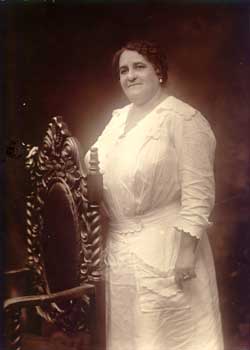 November 2nd
1903
Business and civic leader, Maggie L Walker, opens the St Luke Penny Savings Bank in Richmond, VA,
Background
Maggie Lena Walker (July 15, 1867-December 15, 1934) was an American teacher, businesswoman, and banker. She was the first woman to charter a bank in the United States. As a leader her successes and vision offered tangible improvements in the way of life for African Americans and women. Disabled by paralysis and limited to a wheelchair later in life, she also became an example for persons with disabilities. Her restored and furnished home in the historic Jackson Ward neighborhood of Richmond, Virginia is a National Historic Site operated by the National Park Service.
1875
Democrats suppressed Black vote by fraud and violence and carried Mississippi election. "The Mississippi Plan" staged riots, political assassinations, massacres and social and economic intimidation was used later to overthrow Reconstruction governments in South Carolina and Louisiana.
Background
The Mississippi Plan of 1875 was devised by the Democratic Party to violently overthrow the Republican Party by organized violence in order to redeem the state of Mississippi. The Mississippi Plan was also adopted by Democrats in South Carolina and Louisiana.
Following the end of the American Civil War, blacks found themselves emancipated from the bonds of slavery, and, with the passing of the Fifteenth Amendment to the United States Constitution in 1870, were allowed to vote. The consequences of this were far-reaching and almost immediate. Blacks flooded the polls, and in Mississippi's 1874 election the Republican Party carried a 30,000 majority in what had been, in pre-Civil War years, a Democrat stronghold.
Great African/Jamican Americans
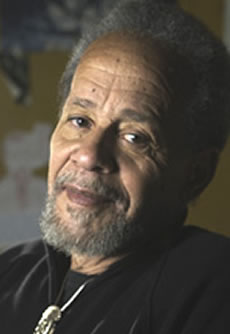
SNCC Activist Ekwueme Michael Thelwell: "People Fought, Died And Bled for the Right to Vote"Listen to Segment Download Show mp3 Watch 128k stream Watch 256k stream Read Transcript
Former field secretary of SNCC, professor Ekwueme Michael Thelwell speaks on the 40th anniversary of the Voting Rights Act at the Grassroots Radio Conference in Northampton, Massachusetts. He discusses today's struggle around strengthening provisions to the act and the role of grassroots media. [includes rush transcript]
On Saturday, the 40th anniversary of the 1965 Voting Rights Act, Amy Goodman spoke with Ekwueme Michael Thelwell, the Jamaican-born novelist and Professor of Afro American studies at the University of Massachusetts, Amherst. He was also the former field secretary for the Student Nonviolent Coordinating Committee (SNCC). While working for SNCC in Washington DC, Thelwell recruited volunteers for the 1964 Freedom Summer campaign in Mississippi, which sent volunteers into the state to register African-American voters.
Thelwell's many accomplishments include his publication “Ready for Revolution,” a compilation of the memoirs of Stokely Carmichael, (Kwame Toure) chair of SNCC and honorary prime minister of the Black Panther Party. Thelwell is also the author of the novel, “The Harder They Come.” Amy Goodman interviewed Thelwell at the 10th annual Grassroots Radio Conference, attended by hundreds of media activists from across the country.
Ekwueme Michael Thelwell, Professor of Afro-American studies at the University of Massachusetts, Amherst. Former Field Secretary of SNCC.
Will Black Voting Rights Expire in 2007?
Netlore Archive: False email rumor claims that the right of African Americans to vote is set to expire in 2007 along with the Voting Rights Act of 1965
Another Internet hoax made headlines recently as the media got wind of the reaction among black Americans to a widely-forwarded email message claiming that their voting rights will vanish in the year 2007. Similar rumors have circulated since the mid-1990s.
The message currently raising concerns reads as follows:
PLEASE PASS THIS ON TO AS MANY PEOPLE AS YOU CAN!!!!
We are quickly approaching the 21st Century and I was wondering if anyone out there knew what the significance of the year 2007 is to Black America? Did you know that our right to vote will expire in the year 2007? Seriously! The Voters Rights Act signed in 1965 by Lyndon B. Johnson was just an ACT.
It was not made a law. In 1982 Ronald Reagan amended the Voters Rights Act for only another 25 years. Which means that in the year 2007 we could lose the right to vote!
Does anyone realize that Blacks/African Americans are the only group of people who still require PERMISSION under the United States Constitution to vote?!
In the year 2007 Congress will once again convene to decide whether or not Blacks should retain the right to vote (crazy, but true). In order for this to be passed, 38 states will have to approve an extension.
In my opinion and many others, this is ludicrous! Not only should the extension be approved, but ... this Act must be made a law. Our right to vote should no longer be up for discussion, review and/or evaluation.
We must contact our Congress persons, Senators, Alderpersons, etc., to put a stop to this! As bona fide citizens of the United States, we cannot "drop the ball" on this one!
We have come too far to let government make us take such a huge step backward. So please, let us push forward to continue to build the momentum towards gaining equality. Please pass this onto others, as I am sure that many more individuals are not aware of this.
[ READ FULL TEXT ]
NOTE: A latter-day version of this message attributes authorship to Camille Cosby, wife of comedian Bill Cosby. She did not write it.
The kernel of truth in the text is that the Voting Rights Act of 1965 is indeed set to expire unless it is renewed by Congress before 2007. The rest of it is false. The basic right of all American citizens to vote, regardless of race, is guaranteed in the Bill of Rights and can't expire with the Voting Rights Act.
The NAACP addressed this issue in a statement quoted in the November 19, 1998 issue of the Internet Tourbus:
African American voting rights were granted by the Fifteenth Amendment, which was passed immediately after the Civil War. Expiration of the Voting Rights Act will not terminate the rights granted under the Fifteenth Amendment.
The U.S. Department of Justice concurs. In its "Voting Rights Act Clarification" dated April 2, 1998, it states:
The basic prohibition against discrimination in voting contained in the Fifteenth amendment and in the Voting Rights Act does not expire in 2007 — it does not expire at all; it is permanent.
The confusion arises from the apparent assumption that it's the Voting Rights Act alone which guarantees suffrage to minorities. In reality, all the Act does is keep in place a set of so-called "extraordinary remedies" meant to enforce the Fifteenth Amendment at state and local levels, where, in defiance of federal law, obstacles to the voting rights of black people were still in place in some parts of the country as of the early 1960s. These remedies, designed specifically to address problems that existed at the time, were never meant to be permanent, which is why the Voting Rights Act comes up for renewal every 25 years.
It's difficult to determine exactly where and when the rumor that African Americans' voting rights will expire in 2007 got started, though Internet discussions of the topic in 1997 made reference to the issue being raised on Tom Joyner's radio talk show. One Usenet posting dated January 21, 1997 is clearly a precursor of the text now circulating.
"I'd say we have gotten hundreds of calls on this over the past two years," South Carolina Representative James Clyburn of told reporters this week. "It's frustrating dealing with this hoax."
And I thought I was the only one who had days like that.
Another Internet hoax made headlines recently as the media got wind of the reaction among black Americans to a widely-forwarded email message claiming that their voting rights will vanish in the year 2007. Similar rumors have circulated since the mid-1990s.
The message currently raising concerns reads as follows:
PLEASE PASS THIS ON TO AS MANY PEOPLE AS YOU CAN!!!!
We are quickly approaching the 21st Century and I was wondering if anyone out there knew what the significance of the year 2007 is to Black America? Did you know that our right to vote will expire in the year 2007? Seriously! The Voters Rights Act signed in 1965 by Lyndon B. Johnson was just an ACT.
It was not made a law. In 1982 Ronald Reagan amended the Voters Rights Act for only another 25 years. Which means that in the year 2007 we could lose the right to vote!
Does anyone realize that Blacks/African Americans are the only group of people who still require PERMISSION under the United States Constitution to vote?!
In the year 2007 Congress will once again convene to decide whether or not Blacks should retain the right to vote (crazy, but true). In order for this to be passed, 38 states will have to approve an extension.
In my opinion and many others, this is ludicrous! Not only should the extension be approved, but ... this Act must be made a law. Our right to vote should no longer be up for discussion, review and/or evaluation.
We must contact our Congress persons, Senators, Alderpersons, etc., to put a stop to this! As bona fide citizens of the United States, we cannot "drop the ball" on this one!
We have come too far to let government make us take such a huge step backward. So please, let us push forward to continue to build the momentum towards gaining equality. Please pass this onto others, as I am sure that many more individuals are not aware of this.
[ READ FULL TEXT ]
NOTE: A latter-day version of this message attributes authorship to Camille Cosby, wife of comedian Bill Cosby. She did not write it.
The kernel of truth in the text is that the Voting Rights Act of 1965 is indeed set to expire unless it is renewed by Congress before 2007. The rest of it is false. The basic right of all American citizens to vote, regardless of race, is guaranteed in the Bill of Rights and can't expire with the Voting Rights Act.
The NAACP addressed this issue in a statement quoted in the November 19, 1998 issue of the Internet Tourbus:
African American voting rights were granted by the Fifteenth Amendment, which was passed immediately after the Civil War. Expiration of the Voting Rights Act will not terminate the rights granted under the Fifteenth Amendment.
The U.S. Department of Justice concurs. In its "Voting Rights Act Clarification" dated April 2, 1998, it states:
The basic prohibition against discrimination in voting contained in the Fifteenth amendment and in the Voting Rights Act does not expire in 2007 — it does not expire at all; it is permanent.
The confusion arises from the apparent assumption that it's the Voting Rights Act alone which guarantees suffrage to minorities. In reality, all the Act does is keep in place a set of so-called "extraordinary remedies" meant to enforce the Fifteenth Amendment at state and local levels, where, in defiance of federal law, obstacles to the voting rights of black people were still in place in some parts of the country as of the early 1960s. These remedies, designed specifically to address problems that existed at the time, were never meant to be permanent, which is why the Voting Rights Act comes up for renewal every 25 years.
It's difficult to determine exactly where and when the rumor that African Americans' voting rights will expire in 2007 got started, though Internet discussions of the topic in 1997 made reference to the issue being raised on Tom Joyner's radio talk show. One Usenet posting dated January 21, 1997 is clearly a precursor of the text now circulating.
"I'd say we have gotten hundreds of calls on this over the past two years," South Carolina Representative James Clyburn of told reporters this week. "It's frustrating dealing with this hoax."
And I thought I was the only one who had days like that.
Affirmative Action: Vote NO!
On November 7th at the voting booth affirmative action will be on the ballot. It has been worded to say if you want the abolish it vote YES. Go to dontvote.com and find out the canidiates postion.
PURPOSE
Affirmative action began as a corrective measure[1] for governmental and social injustices against demographic groups that are said to have been subjected to prejudice in areas such as employment and education. The stated goal of Affirmative Action is to sufficiently counter past discrimination such that a strategy will no longer be necessary: the power elite will reflect the demographics of society at large.
Targeted groups may be characterized by race, gender, or ethnicity. In India, the focus has mostly been on undoing caste discrimination. In South Africa, the focus has been primarily race-based and, to a lesser extent, sex-based discrimination. When members of targeted groups are actively sought or preferred, the reason given is usually that this is necessary to compensate for advantages that other groups are said to have had (such as through institutional racism or institutional sexism or historical circumstances).
The theory is that a simple adoption of meritocratic principles along the lines of race-blindness or gender-blindness will not suffice to change the situation for several reasons:
Discrimination practices of the past preclude the acquisition of 'merit' by limiting access to educational opportunities and job experiences.
Ostensible measures of 'merit' may well be biased toward the same groups who are already empowered.
Regardless of overt principles, people already in positions of power are likely to hire people they already know, and/or people from similar backgrounds.
PURPOSE
Affirmative action began as a corrective measure[1] for governmental and social injustices against demographic groups that are said to have been subjected to prejudice in areas such as employment and education. The stated goal of Affirmative Action is to sufficiently counter past discrimination such that a strategy will no longer be necessary: the power elite will reflect the demographics of society at large.
Targeted groups may be characterized by race, gender, or ethnicity. In India, the focus has mostly been on undoing caste discrimination. In South Africa, the focus has been primarily race-based and, to a lesser extent, sex-based discrimination. When members of targeted groups are actively sought or preferred, the reason given is usually that this is necessary to compensate for advantages that other groups are said to have had (such as through institutional racism or institutional sexism or historical circumstances).
The theory is that a simple adoption of meritocratic principles along the lines of race-blindness or gender-blindness will not suffice to change the situation for several reasons:
Discrimination practices of the past preclude the acquisition of 'merit' by limiting access to educational opportunities and job experiences.
Ostensible measures of 'merit' may well be biased toward the same groups who are already empowered.
Regardless of overt principles, people already in positions of power are likely to hire people they already know, and/or people from similar backgrounds.
Wednesday, November 01, 2006
Statistics show African American men worse off
Black American men suffer far worse health than any other racial group in America. It is accepted that the reasons for this, although complex, include number of well known factors. These include racial discrimination, a lack of affordable health services, poor health education, cultural barriers, poverty, employment that does not carry health insurance, insufficient medical and social services catering for African American men, to name but a few.
African American Male Health Statistics:
African American men live 7.1 years less than other racial groups
They have higher death rates than women for all leading causes of death
They experience disproportionately higher death rates in all the leading causes of death40% of African American men die prematurely from cardiovascular disease as compared to 21% of white men
They have a higher incidence and a higher rate of death from oral cancerAfrican American men are 5 times more likely to die of HIV/AIDS
Other Health Statistics
44% of African American men are considered overweight24% are obese
African American men suffer more preventable oral diseases that are treatable
A higher incidence of diabetes and prostate cancerA high suicide rate. It is the 3rd leading cause of death in 15 to 24 year olds
Ten Leading Causes of death in the U.S.(2001) Blacks and African Americans
Cardiovascular Disease
Cancer
Stroke
Unintentional injuries
Diabetes
Homicide
HIV/AIDS
Chronic lower respiratory disease
Nephritis, Nephrotic syndrome and Nephrosis
SepticemiaSource: Health, U.S., 2003, Table 3
from About.com
African American Male Health Statistics:
African American men live 7.1 years less than other racial groups
They have higher death rates than women for all leading causes of death
They experience disproportionately higher death rates in all the leading causes of death40% of African American men die prematurely from cardiovascular disease as compared to 21% of white men
They have a higher incidence and a higher rate of death from oral cancerAfrican American men are 5 times more likely to die of HIV/AIDS
Other Health Statistics
44% of African American men are considered overweight24% are obese
African American men suffer more preventable oral diseases that are treatable
A higher incidence of diabetes and prostate cancerA high suicide rate. It is the 3rd leading cause of death in 15 to 24 year olds
Ten Leading Causes of death in the U.S.(2001) Blacks and African Americans
Cardiovascular Disease
Cancer
Stroke
Unintentional injuries
Diabetes
Homicide
HIV/AIDS
Chronic lower respiratory disease
Nephritis, Nephrotic syndrome and Nephrosis
SepticemiaSource: Health, U.S., 2003, Table 3
from About.com
Great African Americans
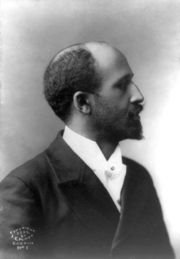
William Edward Burghardt Du Bois (February 23, 1868 – August 27, 1963) was a civil rights activist and leader, sociologist, educator, historian, writer, editor, poet, scholar, and socialist. He became a naturalized citizen of Ghana in 1963 at the age of 95.
David Levering Lewis, his acclaimed biographer, wrote, "In the course of his long, turbulent career, W.E.B. Du Bois attempted virtually every possible solution to the problem of twentieth-century racism—scholarship, propaganda, integration, cultural and economic separatism, politics, international communism, expatriation, third world solidarity." [1]
David Levering Lewis, his acclaimed biographer, wrote, "In the course of his long, turbulent career, W.E.B. Du Bois attempted virtually every possible solution to the problem of twentieth-century racism—scholarship, propaganda, integration, cultural and economic separatism, politics, international communism, expatriation, third world solidarity." [1]
Words to live by
"The common goal of 22 million Afro-Americans is respect as human beings, the God-given right to be a human being. Our common goal is to obtain the human rights that America has been denying us. We can never get civil rights in America until our human rights are first restored. We will never be recognized as citizens there until we are first recognized as humans." -- Malcolm X "Racism: the Cancer that is Destroying America", in Egyptian Gazette (August 25, 1964).
Word of the Day
prevaricate \prih-VAIR-uh-kayt\, intransitive verb:
To depart from or evade the truth; to speak with equivocation.
Journalism has a similar obligation, particularly with men and women suddenly transferred to places of great power, who are often led to exaggerate and prevaricate, all in the name of a supposedly greater good.-- Stephen R. Graubard, "Presidents: The Power and the Mediocrity", New York Times, January 15, 1989
To depart from or evade the truth; to speak with equivocation.
Journalism has a similar obligation, particularly with men and women suddenly transferred to places of great power, who are often led to exaggerate and prevaricate, all in the name of a supposedly greater good.-- Stephen R. Graubard, "Presidents: The Power and the Mediocrity", New York Times, January 15, 1989
Today in Black History
November 1
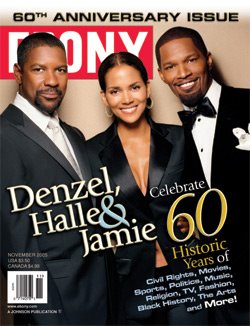
First issue of Ebony magazine published by John H Johnson, 1945
WEB DuBois began publication of NAACP monthly magazine, "Crisis", 1910
Thursday, October 26, 2006
Word of the Day
rapport \ra-POR; ruh-\, noun:
A relation, especially one characterized by sympathetic understanding, emotional affinity, or mutual trust.
He established a tremendous rapport with younger patients and routinely skipped classes and missed tests to take children to the circus or for rides in his convertible, often stopping for ice cream at Frank Monaco's drugstore on the South Side.-- James T. Fisher, Dr. America
Scott and Shackleton could not have been temperamentally more dissimilar and had virtually no rapport.-- Caroline Alexander, The Endurance
A relation, especially one characterized by sympathetic understanding, emotional affinity, or mutual trust.
He established a tremendous rapport with younger patients and routinely skipped classes and missed tests to take children to the circus or for rides in his convertible, often stopping for ice cream at Frank Monaco's drugstore on the South Side.-- James T. Fisher, Dr. America
Scott and Shackleton could not have been temperamentally more dissimilar and had virtually no rapport.-- Caroline Alexander, The Endurance
Today in Black History
October 26
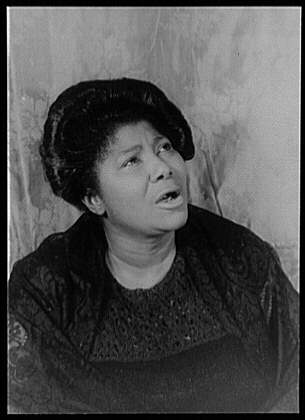
Mahalia Jackson, gospel singer, born 1911 - 1972
Background
Mahalia Jackson (October 26, 1911 – January 27, 1972) was an American gospel singer, widely regarded as the best in the history of the genre.
Well known songs
Trouble of the World
Silent Night
Go Tell It on the Mountain
Amazing Grace
Take My Hand, Precious Lord
Remember Me
Joshua Fit the Battle of Jericho
Holding My Saviour's Hands
Roll Jordan, Roll
The Upper Room
We Shall Overcome
I'm on My Way to Canaan
Silent Night
Go Tell It on the Mountain
Amazing Grace
Take My Hand, Precious Lord
Remember Me
Joshua Fit the Battle of Jericho
Holding My Saviour's Hands
Roll Jordan, Roll
The Upper Room
We Shall Overcome
I'm on My Way to Canaan
Jesus: A Black Man
This article is from ABC News. It is about the new release of a film "Color of the Cross" where Jesus Christ is depicted as a black man. I am especially looking forward to this movie. I found it most interesting to read the statements they have received about the movie, especially the one saying that black people are the only race that do not worship a God in their own image. At the end of the article it is said by the director that having multiple images of Jesus out there spreads the message that color doesn’t matter. Well I believe it does. Jesus was not fair haired and blue eyed. In the Bible, it says his hair was like wool. It is important to depict him correctly.. it is a ploy to make us all worship a man that looks like the ones running the country. Don’t fall into the trap, think for yourself. Its not about separating the races its about empowering them and making them equal, truly. We have been dragged in the dirt for so long we were even given the religion of Christianity by the slave owners. The Arian image of Jesus goes back that far. Like I said it does matter the race because the truth deserves to be told, and reconfirmed.
Here is the article below
Oct. 25, 2006 — It's a familiar image for millions of Christians: Jesus, with a crown of thorns, hanging from the cross.
What color is he?
In a controversial new film opening Friday, he is black.
"Color of the Cross" tells a traditional story, focusing on the last 48 hours of Christ's life as told in the Gospels. In this version, though, race contributes to his persecution.
It is the first representation in the history of American cinema of Jesus as a black man.
"It's very important because [the film] is going to provide an image of Jesus for African-Americans that is no longer under the control of whites," said Stephenson Humphries-Brooks, an associate professor of religious studies at New York's Hamilton College and author of "Cinematic Savior: Hollywood's Making of the American Christ."
What Jesus looked like has long been debated by theologians around the world.
Different cultures have imagined him in different ways, says Stephen Prothero, chairman of the religion department at Boston University.
In Japan, Jesus looks Japanese. In Africa, he is black. But in America, he is almost always white, like the fair-haired savior painted by Leonardo da Vinci in "The Last Supper" in 1495.
Film to Open in Black Neighborhoods
While some black churches have images of a black Jesus behind the altar and others have said that Christ was black, Prothero says "none of those arguments or images have filtered much into the mainstream."
Filmmaker Jean Claude LaMarre set out to change that with "Color of the Cross." LaMarre, who plays Jesus, wrote, directed and financed the film. It will open in 30 theaters in predominantly black neighborhoods.
"Black people in this country are the only race of people who worship a god outside their own image," says LaMarre, 38, adding that showing Christ as a black man is "the most poignant way to deal with the issue of race in this country because it goes to the heart of how we look at the world."
It also provides a positive image of blacks, something that's been scant in the U.S., says the Rev. Cecil "Chip" Murray, longtime leader of L.A.'s First African Methodist Episcopal Church and a producer of the film.
"It could be revolutionary because, for four centuries in our nation, blacks have been at the lowest end of the stratum," he says. "I think it will traumatize the United States more than it will foreign nations who, to some extent, don't have a centuries-old concept of equating black with negativity."
Humphries-Brooks agrees. Other countries are likely to view the film "in a more detached manner," he says, "because of the way (they) see our race-relations problem."
Why does race matter in the story of Christ?
"Jesus isn't in the hands of historians," Prothero says. "What we have now is our own debate and, in that debate, race has to be a factor because race is a big predicament in American life."
Film is a powerful place to have the discussion, says Humphries-Brooks, who calls the medium "one of the last places that is quasi-public for the formation of values in America."
"Artistic and aesthetic views are as important in developing religious values as the words we speak. Everybody goes to the movies. Not everybody goes to the same church."
Filmmaker LaMarre thinks the film can only have a positive effect. "The message is that color, a colored Jesus Christ, doesn't matter," he says. "That's why the movie is important. When you have one prevailing image out there, it suggests color does matter."
from ABC News
Here is the article below
Oct. 25, 2006 — It's a familiar image for millions of Christians: Jesus, with a crown of thorns, hanging from the cross.
What color is he?
In a controversial new film opening Friday, he is black.
"Color of the Cross" tells a traditional story, focusing on the last 48 hours of Christ's life as told in the Gospels. In this version, though, race contributes to his persecution.
It is the first representation in the history of American cinema of Jesus as a black man.
"It's very important because [the film] is going to provide an image of Jesus for African-Americans that is no longer under the control of whites," said Stephenson Humphries-Brooks, an associate professor of religious studies at New York's Hamilton College and author of "Cinematic Savior: Hollywood's Making of the American Christ."
What Jesus looked like has long been debated by theologians around the world.
Different cultures have imagined him in different ways, says Stephen Prothero, chairman of the religion department at Boston University.
In Japan, Jesus looks Japanese. In Africa, he is black. But in America, he is almost always white, like the fair-haired savior painted by Leonardo da Vinci in "The Last Supper" in 1495.
Film to Open in Black Neighborhoods
While some black churches have images of a black Jesus behind the altar and others have said that Christ was black, Prothero says "none of those arguments or images have filtered much into the mainstream."
Filmmaker Jean Claude LaMarre set out to change that with "Color of the Cross." LaMarre, who plays Jesus, wrote, directed and financed the film. It will open in 30 theaters in predominantly black neighborhoods.
"Black people in this country are the only race of people who worship a god outside their own image," says LaMarre, 38, adding that showing Christ as a black man is "the most poignant way to deal with the issue of race in this country because it goes to the heart of how we look at the world."
It also provides a positive image of blacks, something that's been scant in the U.S., says the Rev. Cecil "Chip" Murray, longtime leader of L.A.'s First African Methodist Episcopal Church and a producer of the film.
"It could be revolutionary because, for four centuries in our nation, blacks have been at the lowest end of the stratum," he says. "I think it will traumatize the United States more than it will foreign nations who, to some extent, don't have a centuries-old concept of equating black with negativity."
Humphries-Brooks agrees. Other countries are likely to view the film "in a more detached manner," he says, "because of the way (they) see our race-relations problem."
Why does race matter in the story of Christ?
"Jesus isn't in the hands of historians," Prothero says. "What we have now is our own debate and, in that debate, race has to be a factor because race is a big predicament in American life."
Film is a powerful place to have the discussion, says Humphries-Brooks, who calls the medium "one of the last places that is quasi-public for the formation of values in America."
"Artistic and aesthetic views are as important in developing religious values as the words we speak. Everybody goes to the movies. Not everybody goes to the same church."
Filmmaker LaMarre thinks the film can only have a positive effect. "The message is that color, a colored Jesus Christ, doesn't matter," he says. "That's why the movie is important. When you have one prevailing image out there, it suggests color does matter."
from ABC News
Wear your badge proudly
"The Black skin is not a badge of shame, but rather a glorious symbol of national greatness""
- Marcus Garvey
- Marcus Garvey
Wednesday, October 25, 2006
Word of the Day
crabwise \KRAB-wyz\,
adjective:
1. Sideways.
2. In a cautiously indirect manner.
Grass tells this story in awkward fashion, coming at it crabwise indeed, with hesitations, shifts of direction, and out of sequence, allowing his narrator to display his own confusion, uncertainty, resentment of a history that has deformed his own life.-- Allan Massie, review of Crabwalk, by Gunter Grass, The Scotsman, April 5, 2003
Atwood moves crabwise through such questions as the place of moral or ideological content in art, the conflict between artistic purity and commercial necessity, and the nature of the relationship between writer, text and reader.-- Christopher Tayler, review of Negotiating with the Dead, by Margaret Atwood, Sunday Telegraph, March 10, 2002
adjective:
1. Sideways.
2. In a cautiously indirect manner.
Grass tells this story in awkward fashion, coming at it crabwise indeed, with hesitations, shifts of direction, and out of sequence, allowing his narrator to display his own confusion, uncertainty, resentment of a history that has deformed his own life.-- Allan Massie, review of Crabwalk, by Gunter Grass, The Scotsman, April 5, 2003
Atwood moves crabwise through such questions as the place of moral or ideological content in art, the conflict between artistic purity and commercial necessity, and the nature of the relationship between writer, text and reader.-- Christopher Tayler, review of Negotiating with the Dead, by Margaret Atwood, Sunday Telegraph, March 10, 2002
Is it possible?
Obama Won’t Rule Out White House Run
*U.S. Senator Barack Obama graces the cover of Time this week to tout his new book, “The Audacity of Hope.” In the pages of the magazine, he was asked if he would consider a run for president once the November's midterm legislative elections have ended. The 45-year-old Illinois lawmaker has said no to this question many times before. But on this occasion, he left a crack in the door of a possible White House run. "When the election is over and my book tour is done, I will think about how I can be most useful to the country and how I can reconcile that with being a good dad and a good husband," he is quoted as saying by Time. "I haven't completely decided or unraveled that puzzle yet," said Obama, the only African-American currently serving in the US Senate.http://www.eurweb.com/story/eur29195.cfm
*U.S. Senator Barack Obama graces the cover of Time this week to tout his new book, “The Audacity of Hope.” In the pages of the magazine, he was asked if he would consider a run for president once the November's midterm legislative elections have ended. The 45-year-old Illinois lawmaker has said no to this question many times before. But on this occasion, he left a crack in the door of a possible White House run. "When the election is over and my book tour is done, I will think about how I can be most useful to the country and how I can reconcile that with being a good dad and a good husband," he is quoted as saying by Time. "I haven't completely decided or unraveled that puzzle yet," said Obama, the only African-American currently serving in the US Senate.http://www.eurweb.com/story/eur29195.cfm
My thoughts Exactly
"I am America. I am the part you won't recognize. But get used to me. Black, confident, cocky; my name, not yours; my religion, not yours; my goals, my own; get used to me".
-- Muhammad Ali (born 1942), The Greatest' (1975)
-- Muhammad Ali (born 1942), The Greatest' (1975)
Today in Black History

October 25
Benjamin O Davis Sr became the first Black general in US Army, 1940
Background
Gen. Benjamin Oliver Davis, Sr. (July 1, 1877 – November 26, 1970) was an American general and the father of Benjamin O. Davis Jr. He was the first African-American general in the U.S. Army.
Benjamin O. Davis, Sr., was born in Washington, D.C., on July 1, 1877. His biographer Marvin Fletcher (author of America's First Black General, Benjamin O. Davis, Sr., 1880-1970) has presented evidence of his birth records indicating that he was born in May 1880 and later lied about his age so that he could enlist in the army without the permission of his parents. It is the earlier date that appears on his grave at Arlington National Cemetery, however.) He was a student at Howard University when—as a result of the start of the War with Spain—he entered the military service on July 13, 1898 as a temporary first lieutenant of the 8th United States Volunteer Infantry. He was mustered out on March 6, 1899, and on June 18, 1899, he enlisted as a private in Troop I, U.S. 9th Cavalry Regiment (one of the original Buffalo Soldier regiments), of the Regular Army. He then served as corporal and squadron sergeant major, and on February 2, 1901, he was commissioned a second lieutenant of Cavalry in the Regular Army.
Benjamin O. Davis, Sr., was born in Washington, D.C., on July 1, 1877. His biographer Marvin Fletcher (author of America's First Black General, Benjamin O. Davis, Sr., 1880-1970) has presented evidence of his birth records indicating that he was born in May 1880 and later lied about his age so that he could enlist in the army without the permission of his parents. It is the earlier date that appears on his grave at Arlington National Cemetery, however.) He was a student at Howard University when—as a result of the start of the War with Spain—he entered the military service on July 13, 1898 as a temporary first lieutenant of the 8th United States Volunteer Infantry. He was mustered out on March 6, 1899, and on June 18, 1899, he enlisted as a private in Troop I, U.S. 9th Cavalry Regiment (one of the original Buffalo Soldier regiments), of the Regular Army. He then served as corporal and squadron sergeant major, and on February 2, 1901, he was commissioned a second lieutenant of Cavalry in the Regular Army.
The Rise of Black Consciousness
Steve Biko and the South African Students' Organization
With the ANC and the PAC banned and African political activity officially limited to government-appointed bodies in the homelands, young people sought alternative means to express their political aspirations. In the early 1960s, African university students looked to the multiracial National Union of South African Students (NUSAS) to represent their concerns, but, as this organization adopted an increasingly conservative stance after Vorster's crackdown, they decided to form their own movement. Led by Steve Biko, an African medical student at the University of Natal, a group of black students established the South African Students' Organization (SASO) in 1969 with Biko as president. Biko, strongly influenced by the writings of Lembede and by the Black Power movement in the United States, argued that Africans had to run their own organizations; they could not rely on white liberals because such people would always ally in the last resort with other whites rather than with blacks. He argued that blacks often oppressed themselves by accepting the second-class status accorded them by the apartheid system, and he stressed that they had to liberate themselves mentally as well as physically. He rejected, however, the use of violence adopted by the ANC and the PAC in the early 1960s and emphasized that only nonviolent methods should be used in the struggle against apartheid.
Biko's message had an immediate appeal; SASO expanded enormously, and its members established black self-help projects, including workshops and medical clinics, in many parts of South Africa. In 1972 the Black Peoples' Convention (BPC) was set up to a ct as a political umbrella organization for the adherents of black consciousness. Although the government had at first welcomed the development of black consciousness because the philosophy fit in with the racial separation inherent in apartheid, it sough t to restrict the activities of Biko and his organizations when these took a more overtly political turn. In 1972, SASO organized strikes on university campuses resulting in the arrest of more than 600 students. Rallies held by SASO and the BPC in 1974 to celebrate the overthrow of Portuguese colonialism in Angola and Mozambique resulted in the banning of Biko and other black consciousness leaders and their arraignment on charges of fomenting terrorism.
from Allrefer.com
With the ANC and the PAC banned and African political activity officially limited to government-appointed bodies in the homelands, young people sought alternative means to express their political aspirations. In the early 1960s, African university students looked to the multiracial National Union of South African Students (NUSAS) to represent their concerns, but, as this organization adopted an increasingly conservative stance after Vorster's crackdown, they decided to form their own movement. Led by Steve Biko, an African medical student at the University of Natal, a group of black students established the South African Students' Organization (SASO) in 1969 with Biko as president. Biko, strongly influenced by the writings of Lembede and by the Black Power movement in the United States, argued that Africans had to run their own organizations; they could not rely on white liberals because such people would always ally in the last resort with other whites rather than with blacks. He argued that blacks often oppressed themselves by accepting the second-class status accorded them by the apartheid system, and he stressed that they had to liberate themselves mentally as well as physically. He rejected, however, the use of violence adopted by the ANC and the PAC in the early 1960s and emphasized that only nonviolent methods should be used in the struggle against apartheid.
Biko's message had an immediate appeal; SASO expanded enormously, and its members established black self-help projects, including workshops and medical clinics, in many parts of South Africa. In 1972 the Black Peoples' Convention (BPC) was set up to a ct as a political umbrella organization for the adherents of black consciousness. Although the government had at first welcomed the development of black consciousness because the philosophy fit in with the racial separation inherent in apartheid, it sough t to restrict the activities of Biko and his organizations when these took a more overtly political turn. In 1972, SASO organized strikes on university campuses resulting in the arrest of more than 600 students. Rallies held by SASO and the BPC in 1974 to celebrate the overthrow of Portuguese colonialism in Angola and Mozambique resulted in the banning of Biko and other black consciousness leaders and their arraignment on charges of fomenting terrorism.
from Allrefer.com
Tuesday, October 24, 2006
Word of the Day
solicitous \suh-LIS-uh-tuhs\, adjective:
1. Manifesting or expressing care or concern.
2. Full of anxiety or concern; apprehensive.
3. Extremely careful; meticulous.
4. Full of desire; eager.
He does not appear to have suffered from homesickness, although the suspicion that this might have been due to the unsatisfactory nature of his 'home' life seems belied by the tone and content of his letters; he makes frequent and solicitous inquiries after not only Mabel and his mother but also his father.-- Matthew Sturgis, Aubrey Beardsley: A Biography
She was often solicitous of her daughter's feelings and intense reactions, trying to shield her from emotional trauma.-- Adrienne Fried Block, Amy Beach
1. Manifesting or expressing care or concern.
2. Full of anxiety or concern; apprehensive.
3. Extremely careful; meticulous.
4. Full of desire; eager.
He does not appear to have suffered from homesickness, although the suspicion that this might have been due to the unsatisfactory nature of his 'home' life seems belied by the tone and content of his letters; he makes frequent and solicitous inquiries after not only Mabel and his mother but also his father.-- Matthew Sturgis, Aubrey Beardsley: A Biography
She was often solicitous of her daughter's feelings and intense reactions, trying to shield her from emotional trauma.-- Adrienne Fried Block, Amy Beach
My thoughts exactly
I have a great belief in the future of my people and my country.
--Marian Anderson, 1960
--Marian Anderson, 1960
The Basis of Black Power
The myth that the Negro is somehow incapable of liberating himself, is lazy, etc., came out of the American experience. In the books that children read, whites are always "good" (good symbols are white), blacks are "evil" or seen as savages in movies, their language is referred to as a "dialect," and black people in this country are supposedly descended from savages.
Any white person who comes into the movement has the concepts in his mind about black people, if only subconsciously. He cannot escape them because the whole society has geared his subconscious in that direction.
Miss America coming from Mississippi has a chance to represent all of America, but a black person from either Mississippi or New York will never represent America. Thus the white people coming into the movement cannot relate to the black experience, cannot relate to the word "black," cannot relate to the "nitty gritty," cannot relate to the experience that brought such a word into existence, cannot relate to chitterlings, hog's head cheese, pig feet, ham hocks, and cannot relate to slavery, because these things are not a part of their experience. They also cannot relate to the black religious experience, nor to the black church, unless, of course, this church has taken on white manifestations.
from Marxist History: USA: Black Panther Party: (SNCC)
Any white person who comes into the movement has the concepts in his mind about black people, if only subconsciously. He cannot escape them because the whole society has geared his subconscious in that direction.
Miss America coming from Mississippi has a chance to represent all of America, but a black person from either Mississippi or New York will never represent America. Thus the white people coming into the movement cannot relate to the black experience, cannot relate to the word "black," cannot relate to the "nitty gritty," cannot relate to the experience that brought such a word into existence, cannot relate to chitterlings, hog's head cheese, pig feet, ham hocks, and cannot relate to slavery, because these things are not a part of their experience. They also cannot relate to the black religious experience, nor to the black church, unless, of course, this church has taken on white manifestations.
from Marxist History: USA: Black Panther Party: (SNCC)
"Black Is Beautiful"
So when you use the phrase you know where it came from. Stokely in in the middle of the photo, admist a demostration near the US capital protesting the House of Representatives' action of denying Rep Adam Powell, Jr his seat, 1967.


On 17th June, 1966, Stokely Carmichael, the chairman of the Student Nonviolent Coordinating Committee (SNCC), spoke at a rally in Greenwood, Mississippi, and argued for Black Power. Carmichael defined this as "a call for black people in this country to unite, to recognize their heritage, and to build a sense of community". Carmichael also advocated that African Americans should form and lead their own organizations and urged a complete rejection of the values of American society. Some civil rights groups such as the National Association for the Advancement of Coloured People (NAACP) and Southern Christian Leadership Conference (SCLC), rejected Carmichael's ideas and accused him of black racism. Stokely Carmichael also adopted the slogan of "Black is Beautiful" and advocated a mood of black pride and a rejection of white values of style and appearance. This included adopting Afro hairstyles and African forms of dress. When Carmichael denounced United States involvement in the Vietnam War, his passport was confiscated and held for ten months. When his passport was returned, he moved with his wife, Miriam Makeba, to Guinea, West Africa, where he wrote the book, Stokely Speaks: Black Power Back to Pan-Africanism (1971).
Monday, October 23, 2006
Word of the Day
felicitous \fuh-LIS-uh-tuhs\,
adjective:
1. Suitably applied or expressed; appropriate; apt.
2. Happy; delightful; marked by good fortune.
We do this sort of thing most weekends anyway, said a lean rebel with gunpowder smudges on his face and the felicitous name of Troy Cool.-- Tony Horwitz, Confederates in the Attic
I always have a pad of paper and a pencil within reach, to catch on the wing this turn of phrase which strikes me as felicitous, that idea which I hope to be able to examine more closely in the light of day.-- Roger Martin du Gard, Lieutenant-Colonel de Maumort (translated by Timothy Crouse)
adjective:
1. Suitably applied or expressed; appropriate; apt.
2. Happy; delightful; marked by good fortune.
We do this sort of thing most weekends anyway, said a lean rebel with gunpowder smudges on his face and the felicitous name of Troy Cool.-- Tony Horwitz, Confederates in the Attic
I always have a pad of paper and a pencil within reach, to catch on the wing this turn of phrase which strikes me as felicitous, that idea which I hope to be able to examine more closely in the light of day.-- Roger Martin du Gard, Lieutenant-Colonel de Maumort (translated by Timothy Crouse)
Great African American
Richard Allen (14 February 1760 - 26 March 1831) was an African American pastor and the founder of the African Methodist Episcopal Church. Born as a slave of colonial jurist Benjamin Chew at Germantown, Pennsylvania (now a part of Philadelphia) in 1760, his family was soon sold to a Stockley Sturgis, whose plantation was near Dover, Delaware.
Converted early, he joined the Methodist Society at an early age, and began evangelizing and attending services so regularly that he attracted criticism from local slave owners. In response to this opposition Richard and his brothers redoubled their efforts for Stokely, whom Richard described as "unconverted...but... what the world called a good master". This hard and pious work lead Stokley to encourage preaching amongst his slaves, and soon he was convinced that slavery was wrong, and therefore offered his slaves an opportunity to buy their freedom.
Converted early, he joined the Methodist Society at an early age, and began evangelizing and attending services so regularly that he attracted criticism from local slave owners. In response to this opposition Richard and his brothers redoubled their efforts for Stokely, whom Richard described as "unconverted...but... what the world called a good master". This hard and pious work lead Stokley to encourage preaching amongst his slaves, and soon he was convinced that slavery was wrong, and therefore offered his slaves an opportunity to buy their freedom.
Inspiration
Today I see more clearly than yesterday that back of the problem of race and color, lies a greater problem which both obscures and implements it: and that is the fact that so many civilized persons are willing to live in comfort even if the price of this is poverty, ignorance and disease of the majority of their fellowmen; that to maintain this privilege men have waged war until today war tends to become universal and continuous, and the excuse for this war continues largely to be color and race.
-W.E.B. DuBois
-W.E.B. DuBois
Sunday, October 22, 2006
News Brief
WASHINGTON - Hate crimes in the United States dropped last year by 6 percent, the FBI reported Monday, although violence against people based on their race accounted more than half of the reported incidents. Police nationwide reported 7,163 hate crime incidents in 2005, targeting victims based on their race, ethnicity, religion, sexual orientation and disabilities. That was down from 2004, when the FBI reported 7,649 incidents.The vast majority of hate crimes in both years were motivated by race, according the reports, which detailed the data based on so-called "single-bias" incidents. That means the crime was motivated by only one kind of bias against the victim, according to the FBI.Race-based criminal activity accounted for 54.7 percent of hate crimes last year, up slightly from 52.9 percent in 2004, the FBI found. Another 17 percent of hate crimes in 2005 targeted victims for their religious beliefs, and 14.2 percent for their sexual orientation.Victims were assaulted in more than half — 50.7 percent — of the hate crime cases against people. Six people were murdered and another three were raped in reported hate crimes last year. The rest of the victims, or 48.9 percent, were intimidated, the report shows. The FBI also looked at hate crime incidents that targeted property, with 81.3 percent of cases resulting in damage, destruction or vandalism.Sixty percent of the known offenders in 2005 were white, and 20 percent were black, the report showed.The data was collected from police agencies across the country, representing city, county, state, tribal and federal law enforcement agencies.___The FBI's Hate Crime Statistics 2005 report can be found at: http://www.fbi.gov/ucr/hc2005/index.html
Friday, October 20, 2006
The World Without Black People
Its long but a good read
A World Without Black People This is a story of a little boy name Theo, who woke up one morning and asked his mother, "Mom, what if there were no Black people in the world?" Well, his mother thought about that for a moment, and then said, "Son, follow me around today and let's just see what it would be like if there were no Black people in the world."
Mom said, "Now go get dressed, and we will get started." Theo ran to his room to put on his clothes and shoes. His mother took one look at him and said, "Theo, where are your shoes? And those clothes are all wrinkled, son. I must iron them." However, when she reached for the ironing board, it was no longer there. You see Sarah Boone, a black woman, invented the ironing board, and Jan E. Matzelinger, a black man, invented the shoe lasting machine.
"Oh well," she said, "please go and do something to your hair." Theo ran in his room to comb his hair, but the comb was not there. You see, Walter Sammons, a black man, invented the comb.
Theo decided to just brush his hair, but the brush was gone. You see Lydia O. Newman, a black female, invented the brush. Well, this was a sight: no shoes, wrinkled clothes, hair a mess. Even Mom's hair, without the hair care inventions of Madam C. Walker, well, you get the picture.
Mom told Theo, "Let's do our chores around the house and then take a trip to the grocery store." Theo's job was to sweep the floor. He swept and swept and swept. When he reached for the dustpan, it was not there. You see, Lloyd P. Ray, a black man, invented the dustpan. So he swept his pile of dirt over in the corner and left it there.
He then decided to mop the floor, but the mop was gone. You see, Thomas W. Stewart, a black man, invented the mop. Theo yelled to his Mom, "Mom, I'm not having any luck." "Well, son," she said, "Let me finish washing these clothes, and we will prepare a list for the grocery store."
When the wash finished, she went to place the clothes in the dryer, but it was not there. You see, George T. Samon, a black man, invented the clothes dryer. Mom asked Theo to go get a pencil and some paper to prepare their list for the market.
So, Theo ran for the paper and pencil but noticed the pencil lead was broken. Well, he was out of luck because John Love, a black man, invented the pencil sharpener.
Mom reached for a pen, but it was not there because William Purvis, a black man, invented the fountain pen. As a matter of fact, Lee Burridge invented the typewriting machine and W. A. Lovette the advanced printing press.
Theo and his mother decided just to head out to the market. Well, when Theo opened the door, he noticed the grass was as high as he was tall. You see, John Burr, a black man, invented the lawn mower. They made their way over to the car and found that it just wouldn't go.
You see, Richard Spikes, a black man, invented the automatic gearshift, and Joseph Gammel invented the supercharge system for internal combustion engines. They also noticed that the few cars that were moving were running into each other and having wrecks because there were no traffic signals. You see, Garrett A. Morgan, a black man invented the traffic light.
Well, it was getting late, so they walked to the market, got their groceries, and returned home. Just when they were about to put away the milk, eggs, and butter, they noticed the refrigerator was gone. You see John Standard, a black man, invented the refrigerator. So, they just left the food on the counter.
By this time, Theo noticed he was getting mighty cold. Mom went to turn up the heat, and what do you know? Alice Parker, a black female, invented the heating furnace.
Even in the summertime, they would have been out of luck because Frederick Jones, a black man, invented the air conditioner.
It was almost time for Theo's father to arrive home. He usually takes the bus, but there was no bus, because its precursor was the electric trolley, invented by another black man, Elbert R. Robinson.
He usually takes the elevator from his office on the 20th floor, but there was no elevator because Alexander Miles, a black man, invented the elevator. He also usually dropped off the office mail at a near by mailbox, but it was no longer there because Philip Downing, a black man, invented the letter drop mailbox, and William Barry invented the postmarking and canceling machine.
Theo and his mother sat at the kitchen table with their heads in their hands. When the father arrived, he asked, "Why are you sitting in the dark?" Why? Because Lewis Howard Latimer, a black man, invented the filament within the light bulb.
Theo quickly learned more about what it would be like if there were no black people in the world, especially if he were ever sick and needed blood. Dr. Charles Drew, a black scientist, found a way to preserve and store blood, which led to his starting the world's first blood bank.
Well, what if a family member had to have heart surgery? This would not have been possible without Dr. Daniel Hale Williams, a black doctor, who performed the first open-heart surgery.
So, if you ever wonder, like Theo, where would we be without black people? Well, it's pretty plain to see. We would still be in the DARK!
from- The black history forum at Afrochat (http://www.afrochat.net/forums/showthread.php?s=&t=1943)
A World Without Black People This is a story of a little boy name Theo, who woke up one morning and asked his mother, "Mom, what if there were no Black people in the world?" Well, his mother thought about that for a moment, and then said, "Son, follow me around today and let's just see what it would be like if there were no Black people in the world."
Mom said, "Now go get dressed, and we will get started." Theo ran to his room to put on his clothes and shoes. His mother took one look at him and said, "Theo, where are your shoes? And those clothes are all wrinkled, son. I must iron them." However, when she reached for the ironing board, it was no longer there. You see Sarah Boone, a black woman, invented the ironing board, and Jan E. Matzelinger, a black man, invented the shoe lasting machine.
"Oh well," she said, "please go and do something to your hair." Theo ran in his room to comb his hair, but the comb was not there. You see, Walter Sammons, a black man, invented the comb.
Theo decided to just brush his hair, but the brush was gone. You see Lydia O. Newman, a black female, invented the brush. Well, this was a sight: no shoes, wrinkled clothes, hair a mess. Even Mom's hair, without the hair care inventions of Madam C. Walker, well, you get the picture.
Mom told Theo, "Let's do our chores around the house and then take a trip to the grocery store." Theo's job was to sweep the floor. He swept and swept and swept. When he reached for the dustpan, it was not there. You see, Lloyd P. Ray, a black man, invented the dustpan. So he swept his pile of dirt over in the corner and left it there.
He then decided to mop the floor, but the mop was gone. You see, Thomas W. Stewart, a black man, invented the mop. Theo yelled to his Mom, "Mom, I'm not having any luck." "Well, son," she said, "Let me finish washing these clothes, and we will prepare a list for the grocery store."
When the wash finished, she went to place the clothes in the dryer, but it was not there. You see, George T. Samon, a black man, invented the clothes dryer. Mom asked Theo to go get a pencil and some paper to prepare their list for the market.
So, Theo ran for the paper and pencil but noticed the pencil lead was broken. Well, he was out of luck because John Love, a black man, invented the pencil sharpener.
Mom reached for a pen, but it was not there because William Purvis, a black man, invented the fountain pen. As a matter of fact, Lee Burridge invented the typewriting machine and W. A. Lovette the advanced printing press.
Theo and his mother decided just to head out to the market. Well, when Theo opened the door, he noticed the grass was as high as he was tall. You see, John Burr, a black man, invented the lawn mower. They made their way over to the car and found that it just wouldn't go.
You see, Richard Spikes, a black man, invented the automatic gearshift, and Joseph Gammel invented the supercharge system for internal combustion engines. They also noticed that the few cars that were moving were running into each other and having wrecks because there were no traffic signals. You see, Garrett A. Morgan, a black man invented the traffic light.
Well, it was getting late, so they walked to the market, got their groceries, and returned home. Just when they were about to put away the milk, eggs, and butter, they noticed the refrigerator was gone. You see John Standard, a black man, invented the refrigerator. So, they just left the food on the counter.
By this time, Theo noticed he was getting mighty cold. Mom went to turn up the heat, and what do you know? Alice Parker, a black female, invented the heating furnace.
Even in the summertime, they would have been out of luck because Frederick Jones, a black man, invented the air conditioner.
It was almost time for Theo's father to arrive home. He usually takes the bus, but there was no bus, because its precursor was the electric trolley, invented by another black man, Elbert R. Robinson.
He usually takes the elevator from his office on the 20th floor, but there was no elevator because Alexander Miles, a black man, invented the elevator. He also usually dropped off the office mail at a near by mailbox, but it was no longer there because Philip Downing, a black man, invented the letter drop mailbox, and William Barry invented the postmarking and canceling machine.
Theo and his mother sat at the kitchen table with their heads in their hands. When the father arrived, he asked, "Why are you sitting in the dark?" Why? Because Lewis Howard Latimer, a black man, invented the filament within the light bulb.
Theo quickly learned more about what it would be like if there were no black people in the world, especially if he were ever sick and needed blood. Dr. Charles Drew, a black scientist, found a way to preserve and store blood, which led to his starting the world's first blood bank.
Well, what if a family member had to have heart surgery? This would not have been possible without Dr. Daniel Hale Williams, a black doctor, who performed the first open-heart surgery.
So, if you ever wonder, like Theo, where would we be without black people? Well, it's pretty plain to see. We would still be in the DARK!
from- The black history forum at Afrochat (http://www.afrochat.net/forums/showthread.php?s=&t=1943)
Great African Americans
Charles R. Drew was a teacher, physician and medical researcher. In the latter role, his accomplishments were nothing short of brilliant. Awarded a Rockefeller Fellowship in surgery in 1938 at Columbia University, Drew wrote a doctoral thesis entitled, "Banked Blood." In his research he discovered that by separating plasma (the liquid part of blood) from the whole blood (where the red blood cells exist) and then refrigerating them separately, blood lasted longer and was less likely to become contaminated. Drew also demonstrated that everyone has the same type of plasma; thus, in those instances where a whole blood transfusion is unnecessary, a plasma transfusion could be administered, regardless of blood type. He helped establish a blood bank at Columbia University and became the first African American to receive a Doctor of Medical Science degree from that university.
Controversy around his death:
A rumor spread in the deep south that the "Blood Doctor" died because he was refused a blood transfusion in actuality he died from the severity of his wounds suffered in a fatal car accidents April 1, 1950
A rumor spread in the deep south that the "Blood Doctor" died because he was refused a blood transfusion in actuality he died from the severity of his wounds suffered in a fatal car accidents April 1, 1950
News Brief
Still with the wrap it up campaign and most people with full knowledge that there are many diseases out there that are transmitted sexually people are still having unprotect sex getting infected and within the next three months getting infected again. I guess because there is a magic pill out there it is all good.
They could not learn their lesson the first time, it happens. Instead they keep going and going and before their next oil change they have contracted the same disease. Ever heard that saying, "if you don’t learn from the past you are doomed to repeat it. " That is true in so many ways.
Well I found a website.. Sponsored by the Kinsey Institute they give out free condoms. Enjoy
http://www.condoms4free.com/
The Article from Yahoo News
Many STD patients reinfected within months By Amy Norton Mon Oct 16, 8:53 PM ET NEW YORK (Reuters Health) - Many patients who are treated for chlamydia infection, vaginal trichomoniasis or gonorrhea are infected again within months, U.S. researchers reported Monday. The findings, they say, suggest that anyone diagnosed chlamydia infection or gonorrhea should return to their doctor in three months to be re-tested.People can't rely on symptoms to tell them they're infected, said study leader Dr. Thomas A. Peterman, a researcher with the U.S. Centers for Disease Control and Prevention."These infections are often asymptomatic," Peterman told Reuters Health. "and that's why we need to do re-screening."His team's findings, to be published in Tuesday's issue of the Annals of Internal Medicine, are based on the evaluation of 2,419 patients seen at one of three urban STD clinics. The men were diagnosed with either chlamydial infection or gonorrhea, while the women had one of these STDs or infection with vaginal trichomoniasis.Peterman and his colleagues followed the patients for one year, re-testing them for each of these STDs every three months.They found that 25.6 percent of the women developed a new infection during the follow-up period -- sometimes with the same STD, sometimes with one of the other two. Among the men, 14.7 percent developed a new chlamydia or gonorrhea infection.The risk of reinfection was high at the first three-month screening, the study found, and it remained so for the entire one-year follow-up.Right now, the CDC recommends that women diagnosed with chlamydia be re-screened three months later. The new findings suggest men should follow similar advice, according to Peterman. They also support routine re-testing of men and women with gonorrhea.Although women with trichomoniasis were at risk of repeat STD infection, Peterman said he was "a little more hesitant" to recommend routine re-testing in these cases. Past studies have yielded similar findings when it comes to chlamydia and gonorrhea, he explained, but the overall evidence is not as strong for trichomoniasis.Of men and women who did develop new STD infections during the study, two thirds had no symptoms when diagnosed. So people should not assume they don't need repeat testing because they feel fine, according to Peterman.The high risk of reinfection in the study also points to a need for greater STD prevention, the study authors say. An important step is for infected individuals' partners to be tested."It's critical that your partner also gets treated," Peterman said.He also advised that people diagnosed with an STD "think about" their sexual behavior -- whether they have multiple partners or have unprotected sex, for example -- and make changes that can lower their infection risk.
They could not learn their lesson the first time, it happens. Instead they keep going and going and before their next oil change they have contracted the same disease. Ever heard that saying, "if you don’t learn from the past you are doomed to repeat it. " That is true in so many ways.
Well I found a website.. Sponsored by the Kinsey Institute they give out free condoms. Enjoy
http://www.condoms4free.com/
The Article from Yahoo News
Many STD patients reinfected within months By Amy Norton Mon Oct 16, 8:53 PM ET NEW YORK (Reuters Health) - Many patients who are treated for chlamydia infection, vaginal trichomoniasis or gonorrhea are infected again within months, U.S. researchers reported Monday. The findings, they say, suggest that anyone diagnosed chlamydia infection or gonorrhea should return to their doctor in three months to be re-tested.People can't rely on symptoms to tell them they're infected, said study leader Dr. Thomas A. Peterman, a researcher with the U.S. Centers for Disease Control and Prevention."These infections are often asymptomatic," Peterman told Reuters Health. "and that's why we need to do re-screening."His team's findings, to be published in Tuesday's issue of the Annals of Internal Medicine, are based on the evaluation of 2,419 patients seen at one of three urban STD clinics. The men were diagnosed with either chlamydial infection or gonorrhea, while the women had one of these STDs or infection with vaginal trichomoniasis.Peterman and his colleagues followed the patients for one year, re-testing them for each of these STDs every three months.They found that 25.6 percent of the women developed a new infection during the follow-up period -- sometimes with the same STD, sometimes with one of the other two. Among the men, 14.7 percent developed a new chlamydia or gonorrhea infection.The risk of reinfection was high at the first three-month screening, the study found, and it remained so for the entire one-year follow-up.Right now, the CDC recommends that women diagnosed with chlamydia be re-screened three months later. The new findings suggest men should follow similar advice, according to Peterman. They also support routine re-testing of men and women with gonorrhea.Although women with trichomoniasis were at risk of repeat STD infection, Peterman said he was "a little more hesitant" to recommend routine re-testing in these cases. Past studies have yielded similar findings when it comes to chlamydia and gonorrhea, he explained, but the overall evidence is not as strong for trichomoniasis.Of men and women who did develop new STD infections during the study, two thirds had no symptoms when diagnosed. So people should not assume they don't need repeat testing because they feel fine, according to Peterman.The high risk of reinfection in the study also points to a need for greater STD prevention, the study authors say. An important step is for infected individuals' partners to be tested."It's critical that your partner also gets treated," Peterman said.He also advised that people diagnosed with an STD "think about" their sexual behavior -- whether they have multiple partners or have unprotected sex, for example -- and make changes that can lower their infection risk.